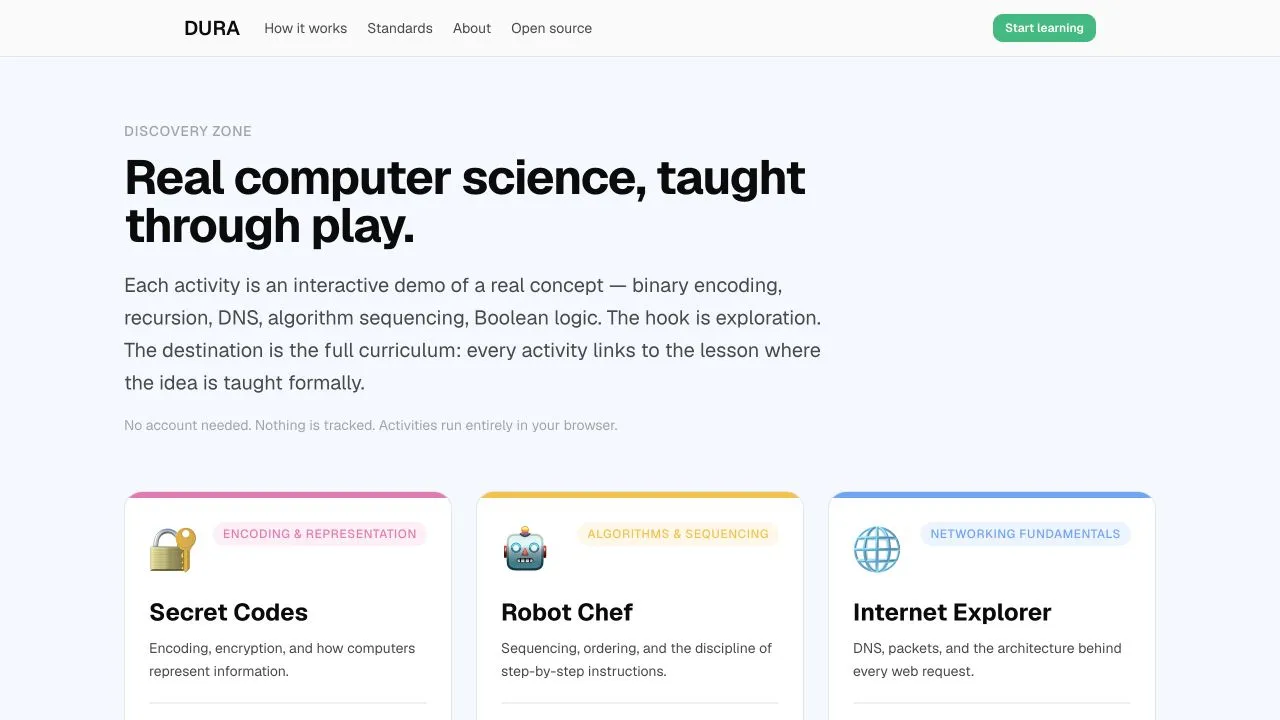
Start with curiosity
Discovery gives a new learner a place to explore before choosing a formal learning path.
Open Discovery
Case study / Software engineering / Independent project
Dustin Snellings’ open-source learning platform: curriculum, offline progress, and an engineering approach grounded in verification.
01 / The problem
A learner may lose their connection, switch devices, or return to a lesson later. DURA is an open-source learning platform built around a simple expectation: the work a learner has done should remain useful when they come back.
I built the curriculum and platform, directing AI-assisted implementation of offline progress, spaced repetition, and in-browser code execution. My manufacturing background informs the approach: define what should hold, then inspect whether it does.
02 / Explore the product
Product walkthrough / Public DURA screens
A short tour of the real product. Screens captured September 12, 2026; open each destination to try it live.
Discovery gives a new learner a place to explore before choosing a formal learning path.
Open Discovery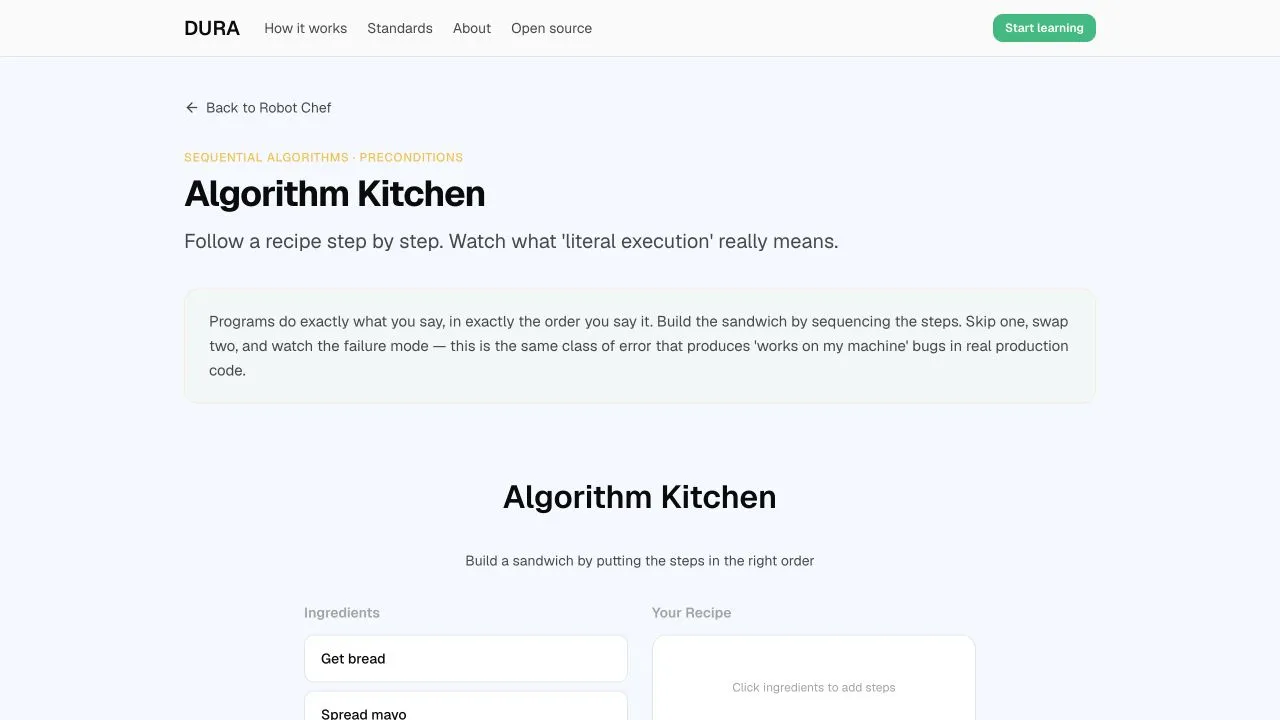
Algorithm Kitchen lets learners arrange instructions and observe what the sequence does. It connects an everyday task to programming concepts.
Try Algorithm Kitchen03 / Decisions and tradeoffs
Lesson identity includes its phase and module. Two lessons named “01” must not share a completion record.
Tradeoff: a longer identifier carries context that a short display number cannot.
Loading and completion can overlap with navigation. The public test suite covers an earlier completion finishing after another lesson has opened.
Tradeoff: asynchronous state needs explicit checks beyond the normal click-through path.
The public project supports local progress and optional cross-device sync. A local-first experience also needs clear rules for restoring, resetting, and reconciling state.
Tradeoff: continuity for the learner requires more lifecycle handling in the implementation.
04 / Read the evidence
The regression suite includes same-number lessons across modules and phases, a reset canceling a pending load, and a completion finishing after navigation. These tests document specific failure cases; their presence alone is not a claim that every production scenario has been validated.
The portfolio’s progress challenge illustrates keeping the higher progress value when reconnecting. It uses sample state, not a live learner account or DURA’s complete synchronization system.
Open the interactive progress challenge ↗05 / What this demonstrates
This case study shows product implementation, state-management decisions, and public regression evidence. It does not claim measured learning gains, adoption, or business outcomes. The walkthrough images are dated captures; the linked product and source continue to evolve.
Public evidence reviewed September 21, 2026: DURA’s project description, repository, and the progress files linked above.